Hera reveals how NASA’s DART impact reshaped an asteroid
New images reveal a crater spanning the impacted face of Dimorphos, a disrupted rotation and hundreds of rocks circling the asteroid pair.
Information checked on:
Key takeaways
- DART shortened Dimorphos's orbital period around Didymos by approximately 33 minutes.
- Hera will investigate the asteroid's properties to improve predictions of future deflection attempts.
New spacecraft images have revealed how dramatically a deliberate collision altered Dimorphos, the asteroid moonlet struck by NASA in 2022. A broad crater occupies its impact-facing side, its rotation is irregular, and hundreds of rocks have been detected around the asteroid pair.
The observations, released by the European Space Agency on November 25, come from Hera, a mission designed to investigate the consequences of NASA's Double Asteroid Redirection Test (DART). Four years after the collision, scientists can now compare direct images of the affected asteroid with predictions derived from Earth-based observations.
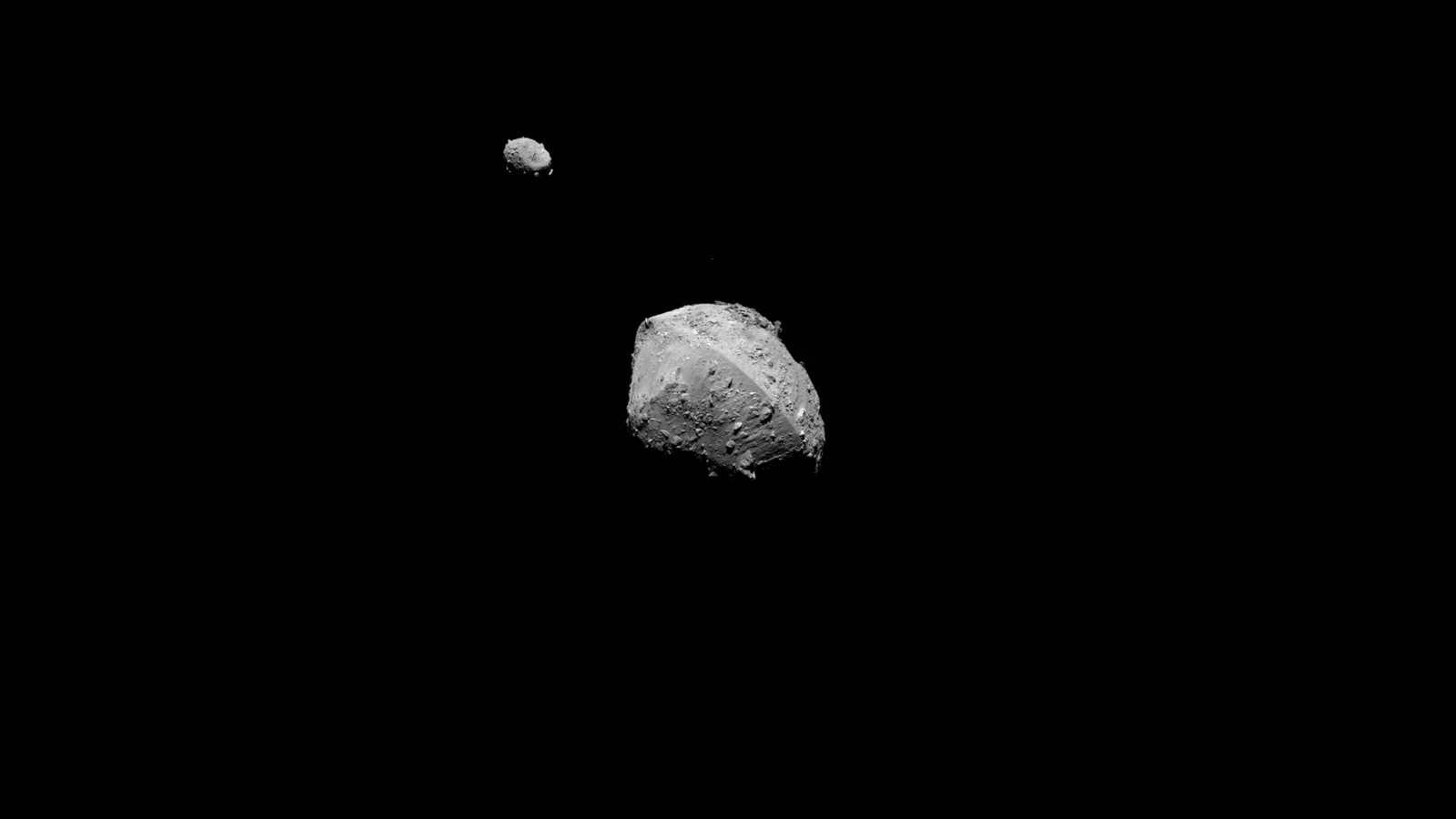
Featured photograph: ©ESA, [Hera Asteroid Framing Camera, November 7, 2026](https://www.esa.int/media/didymos-and-dimorphos-with-dart-impact-site-visible).
A crater spanning the impacted face
Dimorphos is approximately 151 meters across, according to ESA's latest mission report. It travels around Didymos, a much larger asteroid, roughly 730 meters in diameter.
Hera's November 7 photograph, captured from 29 kilometers away, resolves surface features at about 2.7 meters per pixel. The impacted region appears flattened, with a depression nearly as wide as that side of the moonlet. A distinctive elongated feature within the crater has not yet been explained.
The mission's principal investigator, Patrick Michel, described a result more complicated than the alternatives researchers had considered: a crater, a change of overall form and the persistence of some original terrain.
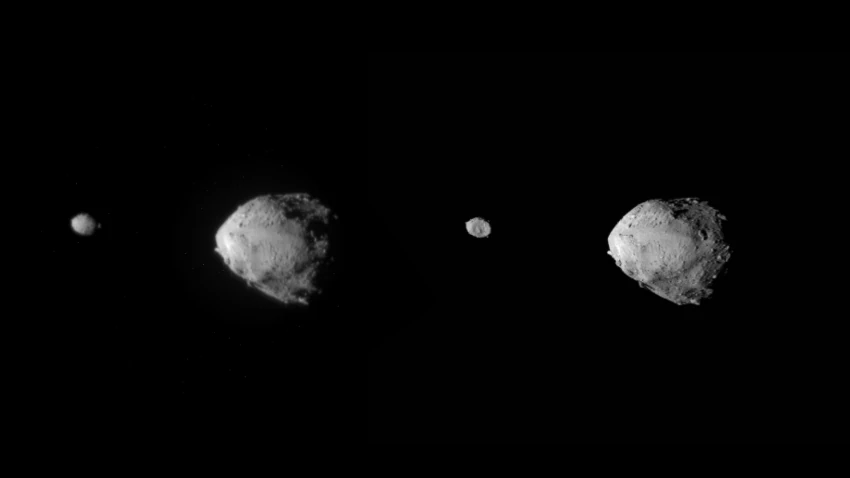
In ESA's before-and-after comparison, familiar features on Didymos remain recognizable, while Dimorphos's impacted side looks substantially different. Other portions of the smaller asteroid still resemble terrain photographed before the collision.
How a spacecraft changed an asteroid's orbit
DART struck Dimorphos on September 26, 2022, at roughly 6.1 kilometers per second. The mission tested whether a spacecraft could transfer enough momentum to shift an asteroid's motion, rather than attempting to destroy it.
A 2024 analysis reported by NASA's Jet Propulsion Laboratory reconstructed the orbital changes using spacecraft imagery, radar and variations in reflected sunlight. It found that Dimorphos's period around Didymos eventually settled at 11 hours, 22 minutes and 3 seconds, a reduction of 33 minutes and 15 seconds.
That is a measurement of the moonlet's revolution around its companion, not its rotation around its own axis.
Momentum from the spacecraft was only part of the explanation. Rock and dust driven away by the impact exerted a recoil on Dimorphos. NASA's analysis of the experiment estimated a momentum enhancement factor of 2.2 to 4.9, depending on the assumed asteroid mass.
This matters for planetary defense: two asteroids struck by identical spacecraft may undergo different deflections because they shed different amounts of material in different directions.
An irregular rotation and hundreds of surrounding rocks
Hera's mission scientist, Michael Kueppers, reported that Dimorphos is tumbling in the aftermath of the collision. Determining its orientation will be important as researchers reconstruct its three-dimensional shape.
Hera has also identified hundreds of meter-scale rocks moving around the system. These objects must be considered when planning observations at closer range.
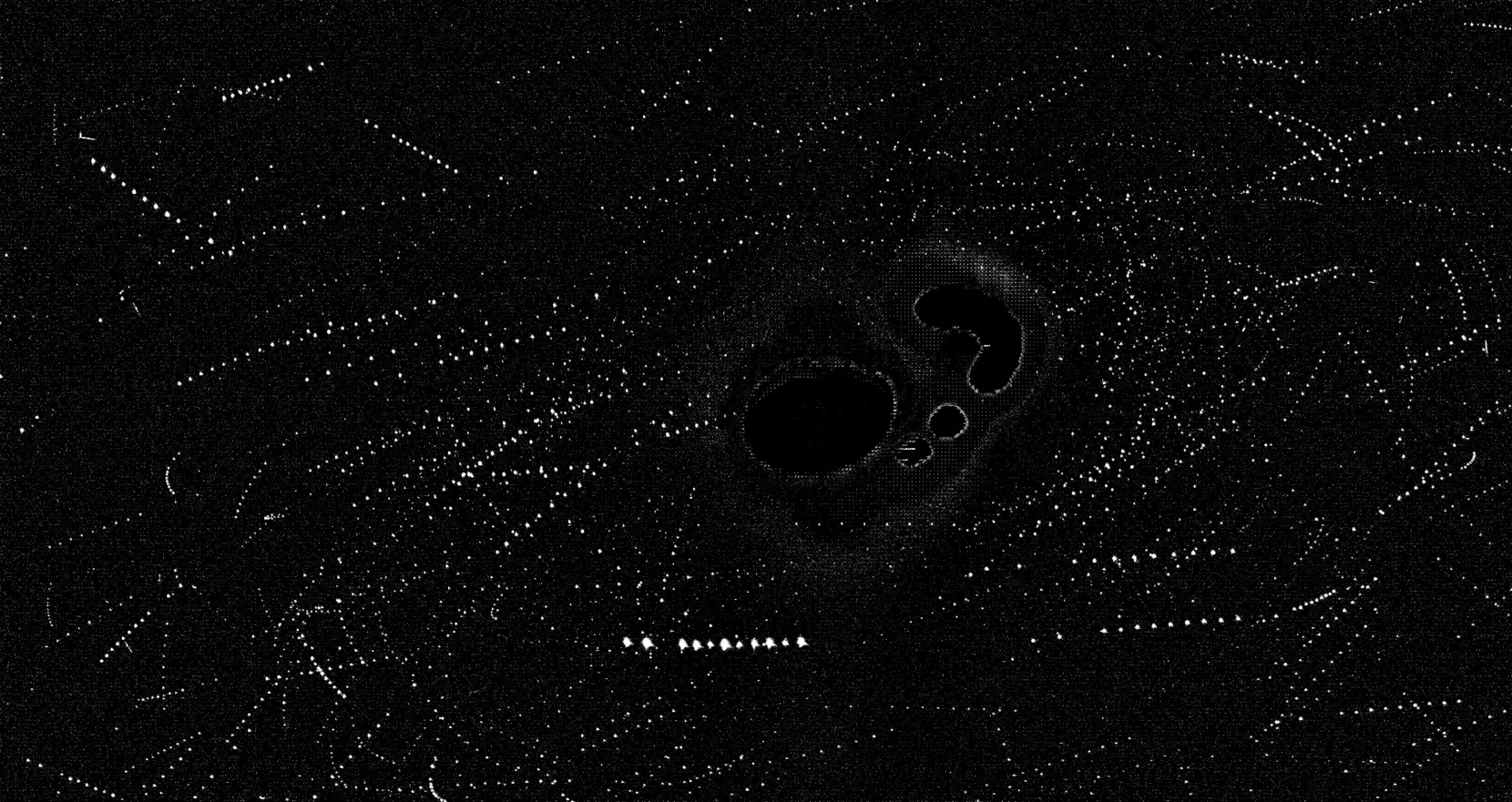
The current observations do not establish the origin of every object. Identifying which material came from the DART collision and understanding its subsequent movement are separate scientific questions.
Why the asteroid's interior matters
Many small asteroids are aggregates of fragments rather than solid pieces of rock. The distribution of these fragments, their packing and their cohesion influence how an impact propagates through the body.
A 2024 study in Nature Astronomy used simulations to investigate how Dimorphos responded to DART. Hera provides an opportunity to test such models against direct measurements.
Determining the asteroid's mass will be particularly valuable. Researchers need that measurement to estimate the momentum transferred during the impact and constrain predictions about how other asteroids might respond.
What Hera will investigate next
ESA plans to move Hera closer to the pair in December. In January 2027, the mission is expected to deploy two small spacecraft, Juventas and Milani.
Juventas carries radar to investigate the subsurface. Milani will study asteroid materials and nearby dust. Their measurements will complement Hera's imaging and help constrain the physical properties underlying the deflection.
Neither Didymos nor Dimorphos was on a collision course with Earth when DART was conducted. The mission was a controlled planetary-defense experiment.
The challenge now is to turn the demonstrated orbital change into a method that can be modeled reliably for objects with different sizes, structures and compositions.
FAQ
Did DART change the asteroid's orbit around Earth?
No. The approximately 33-minute reduction refers to Dimorphos's orbital period around Didymos. Neither asteroid was an Earth-impact threat during the experiment.
Sources & Verification
Reporting checked November 27, 2026. The new findings are attributed to ESA; the earlier orbital measurements and momentum estimates are attributed to NASA and the published research. DECODISTA did not independently analyze spacecraft telemetry.
- ESA: Hera's November 25 mission findings
- ESA: Hera's approach to the target asteroids
- NASA/JPL: Dimorphos orbital and shape changes
- NASA: kinetic impact and momentum transfer
- Nature Astronomy: Dimorphos impact simulations
- ESA: image use conditions
Image provenance: the featured photograph and comparison were retrieved from ESA's published source files. The HyperScout-H composite was retrieved from the ESA media rendition. The hero has been resized with black padding to fit the site layout; the original framing is preserved. All three are mission images, not generated illustrations.