How to Spot a Fake Online Store: 10 Checks Before You Buy
Fake stores can look credible and even appear in search ads. Use ten practical checks, a real FTC-documented example, and official recovery routes before you buy.
Information checked on:
Key takeaways
- Paid search advertisements can lead to impersonation stores; prominent placement is not proof of legitimacy.
- Verify the seller and actual registered domain before buying from a new website.
- Compare the exact product, condition, shipping fees and return terms rather than the discount alone.
- HTTPS encrypts the connection but does not certify that a business is honest.
- Beware requests for hard-to-reverse payments or unrelated passwords and verification codes.
- Contact your payment provider promptly and preserve evidence if you've already paid a suspicious seller.
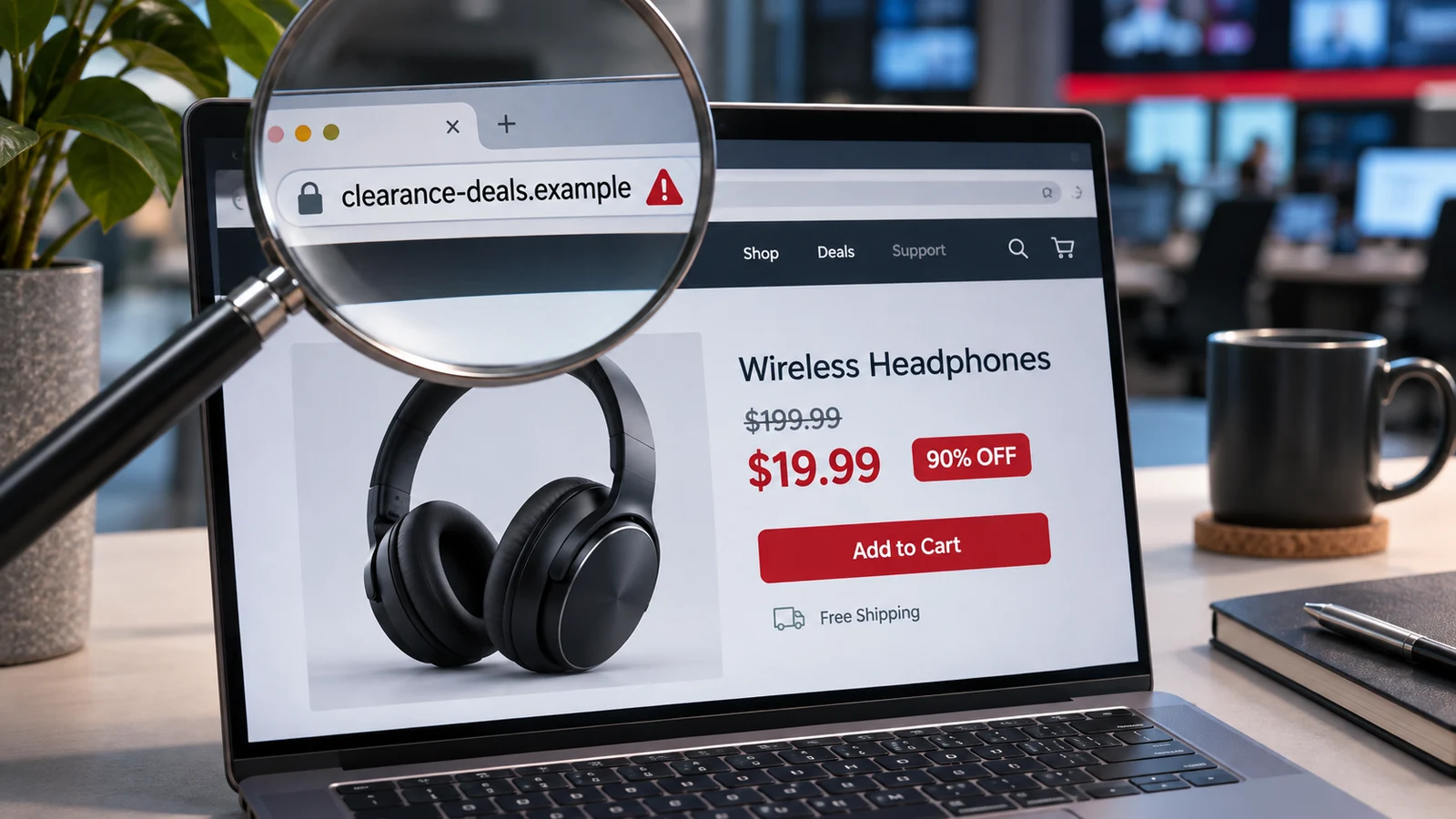
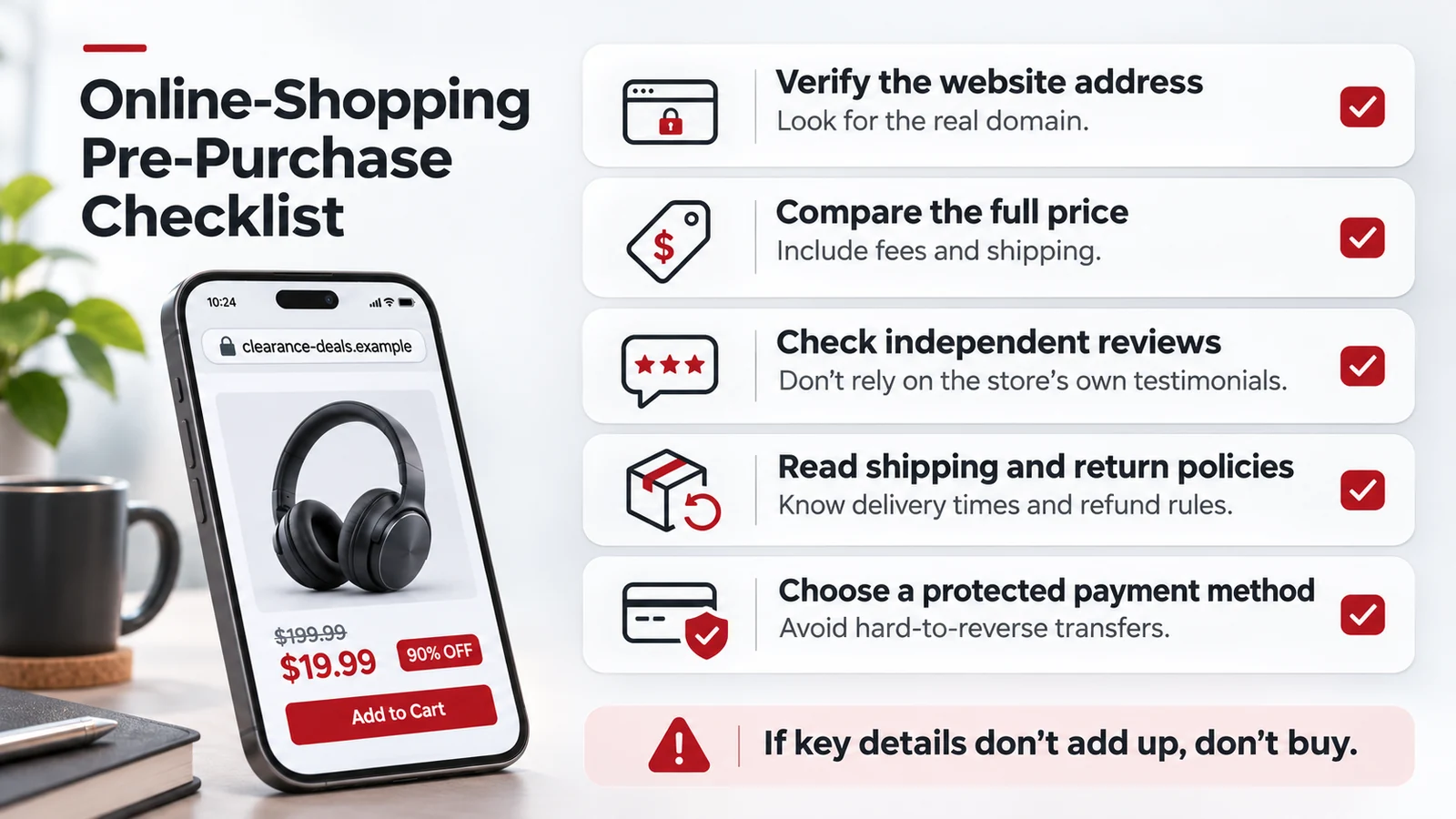
A pair of wireless headphones normally costs about $199.99. An unfamiliar website is selling the same model for $19.99. The product photographs look professional, the customer ratings are excellent, and a countdown timer warns that the offer is about to expire.
Would you buy?
It is not always easy to recognize a fraudulent online store by appearance. Some impersonate established brands, copy legitimate product photographs, and pay to advertise in search results. On November 19, 2026, the US Federal Trade Commission (FTC) warned that scam shopping sites can appear in paid search ads, sometimes alongside legitimate retailers.
The issue is especially relevant around Black Friday and holiday sales, but the underlying tricks are not seasonal. The FTC reported in August 2026 that consumers disclosed more than $95 million in losses during 2025 from scams that began when they ordered products after seeing social-media ads. That is a reported-loss figure for this specific category, not all online shopping fraud.
There is no single test that certifies a store as legitimate. These ten checks help you evaluate the evidence before entering payment information.
Quick comparison: what deserves closer inspection?
| Check | More reassuring | Investigate further |
|---|---|---|
| Web address | Matches the seller's independently verified domain | Imitates a brand with additional words or misleading subdomains |
| Price | Comparable for the same model, condition and fees | Extraordinary discount without a credible explanation |
| Business | Identifiable seller with consistent information | Copied, contradictory or unverifiable contact details |
| Reviews | Detailed experiences across independent sources | Only glowing testimonials on the seller's own site |
| Policies | Clear delivery, refund and return terms | Missing, contradictory or unclear conditions |
| Payment | Checkout with understandable dispute protections | Pressure to use hard-to-reverse transfers |
These are clues, not a fraud score. A new legitimate store may have few reviews; a convincing scam can pass superficial checks.
1. Check the actual web address
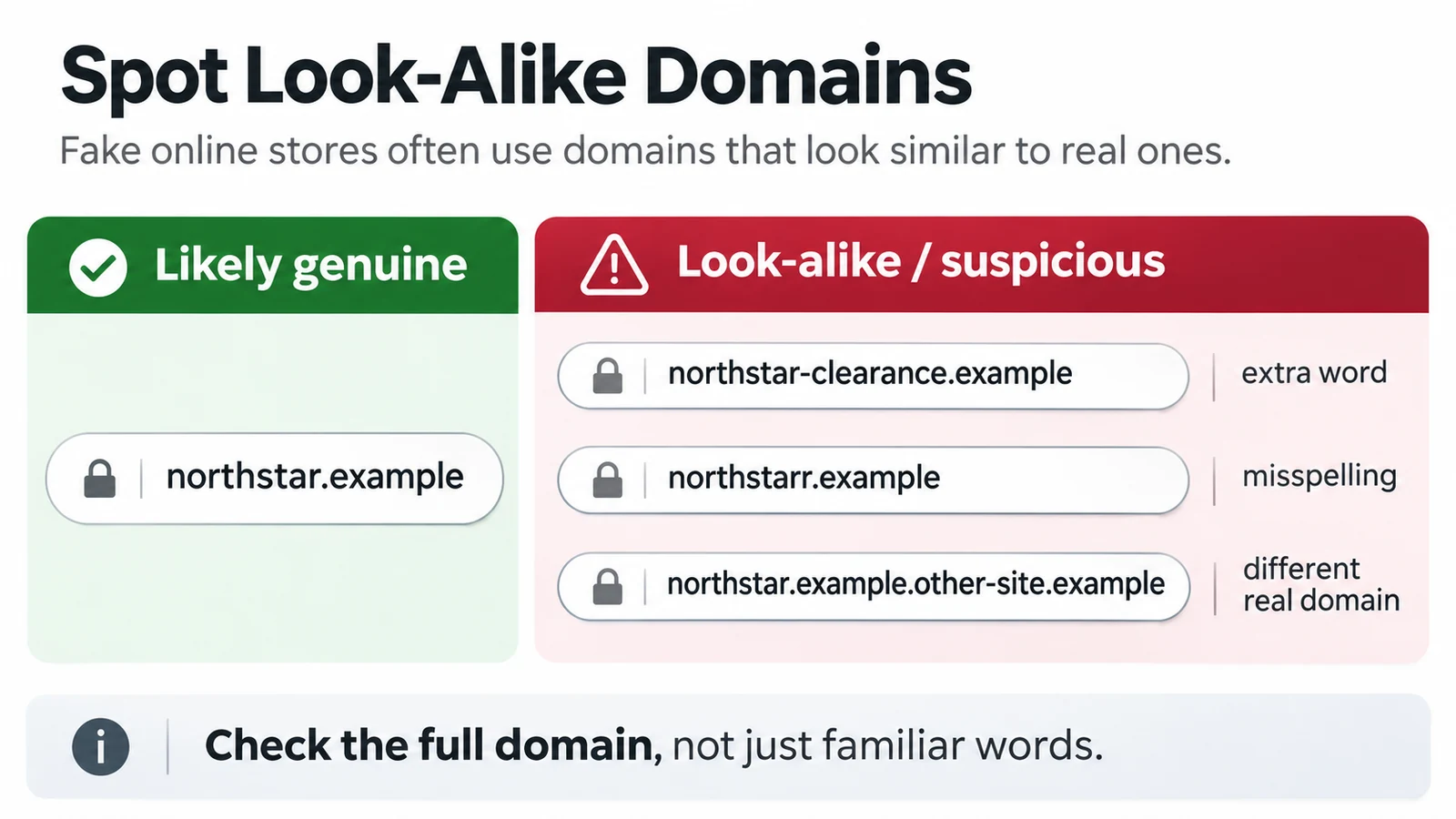
A familiar logo does not prove that the website belongs to the company it claims to represent. Scammers can create look-alike domains by adding terms such as “outlet,” “official,” or “clearance.”
For example, if a fictional retailer's verified domain were northstar.example, northstar-clearance.example would be a different site. Both are illustrative domains, not real retailers. A more subtle trick is a subdomain such as northstar.example.other-site.example: the relevant registered domain is other-site.example.
Before you buy: Independently find the retailer's official address and compare the complete domain. Do not use a link supplied by the suspicious store to verify itself.
2. Look past paid search results
A search advertisement can be prominent without being trustworthy. The FTC's November 2026 advice is to scroll beyond paid results, investigate an unfamiliar seller and enter a company's known web address directly when possible. Organic results are ranked differently from ads, but they are not guaranteed to be safe.
If the offer came from a social-media ad, apply the same checks to the destination website. Ad placement is not a business certification.
Before you buy: Find the official store independently rather than treating a top-ranked ad as proof.
3. Compare the exact product and full price
A $19.99 offer for a product usually sold for about $199.99 deserves scrutiny. A legitimate clearance or refurbished item might explain the difference, but the model number, condition, warranty and region should support that explanation.
Also compare shipping fees and taxes. A cheap headline price is not the full cost of a purchase.
Before you buy: Compare the identical item and specifications with several established retailers. Do not let a countdown timer replace verification.
4. Verify who operates the store
Look for an identifiable business name, a way to contact support and, where appropriate, official registration information. A displayed address or phone number alone is not proof; these details can be copied from other businesses.
Try asking a specific question about stock, shipping or returns. A response may help, but it is stronger when its details match information you can verify independently.
Before you buy: Establish who will receive your money and who would be responsible if the order goes wrong.
5. Read reviews from independent sources
A seller can publish convincing-looking five-star testimonials. Search the exact store name or domain with words such as reviews, complaints, refund and scam. Look for patterns in specific order and delivery experiences, not just star averages.
The FTC's online shopping advice recommends examining multiple review sources and researching the seller. Remember that even independent reviews can be manipulated, and a new store may have little history.
Before you buy: Consider the reviews alongside the seller's identity and purchase terms, rather than treating ratings as a verdict.
6. Read delivery and refund terms
Check the delivery promise, return address, shipping charges, refund exclusions and any restocking fee. Save a copy of the terms available at checkout.
For most US transactions covered by the FTC's Mail, Internet, or Telephone Order Merchandise Rule, a seller generally must have a reasonable basis to ship by the promised time. If no shipping date is stated, the usual default is 30 days, subject to specified exceptions. If the seller cannot ship within the applicable period, it must follow the rule's delay-notice, consent, cancellation and refund requirements. Consumer rights elsewhere differ.
Before you buy: Make sure you understand what happens if the item is late, defective or never arrives.
7. Evaluate the payment method
The FTC warns that scammers often request payments that are hard to reverse, including gift cards, cryptocurrency, wire transfers and certain direct payment-app transfers. These payment methods are not inherently fraudulent; the circumstances and recovery rights matter.
In the United States, credit cards generally provide important dispute protections for qualifying purchases. Other payment methods and jurisdictions have different rules. A store insisting that you leave an established marketplace's normal checkout is another reason to be cautious.
Before you buy: Read the provider's buyer-protection terms and avoid unusual instructions to pay an unverified recipient.
8. Understand the limit of HTTPS
An HTTPS connection helps encrypt data in transit and authenticate the domain you connected to. It does not prove that the seller is honest. A fraudulent website can obtain an HTTPS certificate and display copied security badges.
Before you buy: Require a secure connection for payment details, but verify the business separately.
9. Resist urgency and unusual checkout requests
Limited-time offers and stock warnings are ordinary marketing techniques, not automatic proof of fraud. They become more concerning alongside implausible prices, unclear seller details and payment pressure.
Never provide unrelated passwords, email login credentials or one-time banking codes simply to complete a routine purchase.
Before you buy: Stop if checkout redirects to an unexpected site or asks for credentials that are unnecessary for the transaction.
10. Use safety tools as supporting evidence
Browser warnings and reputation tools can flag known malicious websites. Google Safe Browsing supplies threat information used by participating applications, but a clean result is not a guarantee that a retailer will fulfill orders. New fraudulent sites may not yet be identified.
DECODISTA explains Chrome's security options in its Enhanced vs Standard Protection guide. These protections complement, rather than replace, checking a seller.
Before you buy: Treat automated checks as one piece of evidence, not a pass-or-fail certificate.
A documented example: fake JOANN clearance-sale sites
This is not just a hypothetical pattern. In May 2025, the FTC warned about websites impersonating JOANN Fabric & Craft during its store-closing sales. The FTC said the genuine clearance sales at that time were in physical stores only, while scam advertisements promoted fake online deals claiming 80–90% discounts.
According to reports described by the FTC, shoppers who paid through the imitation sites received receipts, but the payments went to parties other than JOANN and the orders were unlikely to arrive.
The case illustrates three practical checks: confirm that the retailer is actually running the advertised promotion, compare the destination website with its verified address, and check the name of the payment recipient. This section describes the FTC's 2025 warning; it is not a claim about any present-day JOANN sale or an independent DECODISTA investigation.
The five-question check before buying
- Identity: Can I independently verify this domain and business?
- Price: Is this the exact product, with a credible price and full cost?
- Evidence: Can I find independent information about fulfilled orders?
- Terms: Are shipping, returns and refunds understandable?
- Payment: Do I understand my protections if something goes wrong?
A missing review or an unusually low price alone may not prove fraud. But if critical details conflict or the seller insists on a suspicious payment route, choosing another store is reasonable.
What if you've already paid a suspected scammer?
Contact your bank or payment provider immediately. Use an independently verified support number or official app. Ask about blocking further charges and applicable disputes or recovery options; no refund is guaranteed.
Preserve evidence. Save order emails, transaction references, screenshots, the URL, the advertised delivery date and communications.
Secure your accounts. If you reused a password on the suspicious site, change it everywhere it was used. Enable multifactor authentication. Ask your bank whether exposed card details should be replaced. If you exposed Google Account credentials, use DECODISTA's official-route Gmail account recovery guide rather than trusting someone offering paid recovery.
Beware recovery scams. Fraud victims are sometimes targeted again by people claiming they can retrieve lost money for an upfront fee. For related impersonation tactics, see DECODISTA's fake tech-support and verification-code scam guide.
Report the incident through the official service where you live. Look for your country or region's consumer-protection authority, national cybercrime-reporting service, or police fraud-reporting channel. Find its website independently through a verified government or law-enforcement source rather than a link sent by a stranger. Reporting helps authorities identify patterns, but does not guarantee reimbursement.
Report the suspicious listing or advertisement, too. If you encountered the store through a marketplace, search ad, or social-media platform, use that platform's official reporting tools. Reporting an ad is separate from asking your bank or payment provider to dispute a transaction.
If the purchase crossed borders, tell your payment provider and local reporting authority where the seller appears to operate. Consumer protections, available agencies, and recovery options vary by jurisdiction. For an urgent payment problem, contact your financial institution first.
FAQ
Are stores in Google ads automatically legitimate?
No. Scammers can pay for search ads. Check the actual domain and seller before buying, even if an advertisement appears beside well-known retailers.
Does a padlock mean a store is safe?
No. HTTPS protects the connection but does not certify the retailer's business practices.
Is an extremely cheap product always a scam?
No. Refurbished goods and genuine promotions can be inexpensive. Check the exact item, condition, seller and purchase terms.
Can a fraudulent store have customer reviews?
Yes. Reviews on the seller's website can be copied, fabricated or selectively displayed. Seek independent evidence and look for consistent patterns.
Can a website checker guarantee a store is legitimate?
No. It may detect known security threats but cannot guarantee fulfillment or honest trading.
Is credit-card payment safer?
Credit cards can provide meaningful dispute rights, particularly in the United States, but protections depend on the transaction and country. Recovery is not guaranteed.
Can I get my money back after paying a fraudulent seller?
Possibly. Contact your payment provider promptly, preserve evidence and follow the relevant dispute process. The outcome depends on the method, jurisdiction and circumstances.
Final takeaway
A fake online store may have attractive product photos, a secure connection, persuasive reviews and prominent advertising. None of those features alone makes it trustworthy.
Check the domain, the seller, the complete offer and the payment arrangement. If important details do not add up, you do not need to prove fraud before deciding not to buy.
Sources & Verification
DECODISTA reviewed official consumer-protection guidance and technical documentation available through November 22, 2026, including the FTC's November 2026 search-ad alert, May 2025 JOANN impersonation alert, August 2026 social-media-ad alert, online-shopping guide, merchandise shipping rule guidance, and what-to-do-after-a-scam guide. Readers should use independently verified national or regional reporting services applicable to their location.
The introductory headphone offer and illustrative .example domains are fictional. No store was directly tested or independently accused of fraud by DECODISTA. This article is general consumer-safety information, not individualized legal or financial advice.